Rodents

Rodents in Saskatchewan

There are twenty-seven species of rodents found in Saskatchewan, ranging from the tiny Western jumping mouse all the way to the largest rodent, the North American beaver.

Mice

There are at least seven species of mice that live in Saskatchewan, from smallest to largest: Western jumping mouse, meadow jumping mouse, northern grasshopper mouse, white-footed mouse, deer mouse, house mouse and olive-backed pocket mouse.

Shrew

Similar to mice, shrew are abundant in Saskatchewan. There are multiple species found in our province, including the common shrew, pygmy shrew, American water shrew, Arctic shrew, prairie shrew, dusky shrew, and the northern short-tailed shrew.

Unlike mice, shrew tend to be far more secretive and are often found in moist micro-habitats such as those near wetlands, in forests and in fields. Shrew are primarily insectivores and play an important role in controlling insect populations on the prairies.

Chipmunks

In Saskatchewan, we have only one species of chipmunk: the least chipmunk (Tamias minimus). The least chipmunk is the smallest of all chipmunk species and can be identified by their distinct appearance: orange-brown fur, a grey-white underside, a long, bushy tail and stripes both along their sides and on the face.


Voles

Voles are smaller than mice. Multiple species can be found in our province, from the far north to the deep south: western heather vole, taiga vole, meadow vole, prairie vole, sagebrush vole, and the southern red-backed vole.

Pocket gophers

Pocket gophers are sometimes called moles because of their extensive tunnelling systems that create distinct mounds of soil in gardens and yards. However, there are no true mole species in Saskatchewan.

Pocket gophers have distinct ‘chubby cheeks’, which are actually fur-lined ‘pockets’ within their cheeks that are used to store food. Like all adept digging animals, pocket gophers have long front claws. They can be identified by these distinct traits, but they resemble most other rodents in Saskatchewan, with light brown fur and pale undersides.

Woodchucks

Sometimes referred to as a groundhog, the woodchuck is a marmot species that prefers to inhabit open areas like fields, clearings, and open forests. Due to their preference for mountain ranges and colder landscapes, woodchucks can be found in the northern most reach of Saskatchewan.

Woodchucks are large marmots with thick legs, long claws on their forefeet, a short, bushy tail, and fur ranging from yellow to dark red-brown with the majority of woodchucks being an intermediate brown.

Ground squirrels

Saskatchewan is home to three different species of ground squirrel: the thirteen-lined ground squirrel, the Franklin’s ground squirrel, and the Richardson’s ground squirrel (Urocitellus richardsonii).

Thirteen-lined ground squirrel (Ictidomys tridecemlineatus)

  • These distinct gophers are named for the thirteen lines that run from the back of their neck to the base of their tail. In addition to these stripes, they have smaller rectangular spots that trail their midline. Their preferred habitat is open, short-grass prairie, where they create burrows in the sandy soil. As human settlements expanded, thirteen-lined ground squirrels began to make their homes on mowed lawns, golf courses, and within parks, where we often see them today.

Franklin’s ground squirrel (Poliocitellus franklinii)

  • The least common and least known of all the ground squirrels is the Franklin’s ground squirrel. They are often referred to as “bush gophers” because of their preferred habitat of dense shrub cover and parkland. In other provinces, such as Alberta, observations of Franklin’s ground squirrels should be reported to Nature Alberta or via iNaturalist, given the limited information on their distribution throughout the province.
  • Franklin’s ground squirrels don’t look like the ground squirrels we are used to in Saskatchewan, the Richardson’s ground squirrel. The Franklin’s ground squirrel is a large rodent with a long, bushy grey tail, a grey head, and a reddish-brown body with a yellowish-white underbelly.

Richardson’s ground squirrel (Urocitellus richardsonii)

  • If you live anywhere in Saskatchewan, you are more than familiar with the Richardson’s ground squirrel for one reason or another. They are often found in large colonies, dispersed throughout agricultural land, parks, and school grounds.
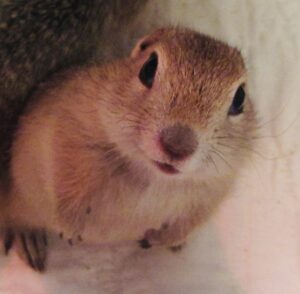
  • Often referred to as ‘prairie dogs’, Richardson’s ground squirrels are slender with light brown fur and a white underbelly, and short, thin tails. They are often seen standing on alert at the entrance to their burrows, flicking their tails, and ‘barking’ to each other.
  • In the prairie provinces, especially Saskatchewan, Richardson’s ground squirrels are persecuted for their presence on agricultural and pasture land. In 2021, the Pest Management Regulatory Agency of Health Canada de-registered strychnine for use in controlling the Richardson’s ground squirrel population, but the battle for humane control methods continues at LSWR, as alternative poisons have been relied on in the absence of strychnine, including Rozol and other anticoagulant rodenticides. To learn more about our stance on rodenticide use and what we are doing about it, read up on our advocacy project here.
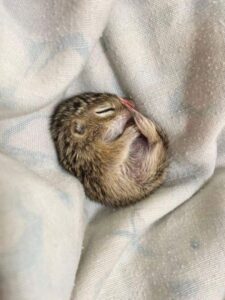
A juvenile thirteen-lined ground squirrel previously in care at LSWR.
A juvenile thirteen-lined ground squirrel.
A Richardson's ground squirrel previously in care.
A Richardson’s ground squirrel previously in care.

Rodent Species at Risk

Ord’s Kangaroo Rat (Dipodomus ordii)

Ord’s kangaroo rat was designated as Endangered in 2007, and has been protected ever since. They are only found in and around Suffield, Alberta, with some locations identified outside of Medicine Hat, Alberta, as being favourable habitat for them.

These rodents are not true rats and are not closely related to the Norway rats found in our province. They are the only species of kangaroo rat found in Canada and are easily distinguishable from other small rodents. They have reduced front limbs, large hind legs and feet that give them their impressive hopping abilities, and have a long, tufted tail that is more than half the total length of their body. Their fur is primarily orange-brown with some distinct white markings on the head, underbelly and their hips.

Ord’s kangaroo rats are Endangered due to the devastation that human disturbance, habitat loss and and agricultural production have had on their population. To learn more about how to protect the Ord’s kangaroo rat, read up on Nature Canada’s website here.