
Natural History of Raccoons
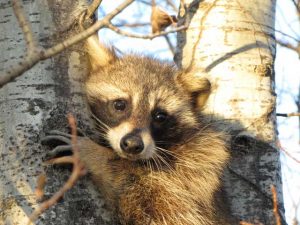
Raccoons are known as “bandits”, both for the dark ‘mask’ across their face and for their ability to be destructive to property, crops and birds.
Raccoons are intelligent animals that contribute to the problem they pose. While raccoons are mainly nocturnal, they are known to come out during the day for food. They swim well and enjoy crayfish in their diet.
Contrary to popular belief, raccoons do not wash all their food. They may wash food to remove excess sand or grit. They are excellent climbers, which allows them to access rooftops and attics, much to the annoyance of homeowners.
Raccoons will eat just about anything: vegetables, meat, fish, insects, eggs and berries, to name a few items. Raccoons are fairly new to Saskatchewan, having come in from the south.
They are working their way north and have been found as far as Prince Albert. They enjoy wooded or swampy areas with enough food, water and available den sites. They have a litter in the spring of 5-6 young who often stay with the mother through the winter and disperse in the spring.
The males and females do not stay together outside of the mating season. The female raises the young on her own. If disturbed, the mother raccoon will move the young to a different den site. She has been known to return for her young even after 24-48 hours of separation due to a disturbance.
What to Do When…
Raccoons keep getting into my garbage.
Overflowing or uncovered garbage cans provide an open invitation to hungry raccoons. If possible, the simplest solution is to keep your waste where the raccoons cannot access it and put it out for pickup in the morning, when they have returned to their dens for the day.
If the can is accessible, try a plastic garbage can with a tall (4′ high) twist-on lid which raccoons cannot open. A simple wooden box to hold the garbage cans with a hinged lid for human access is another option. Bungee cords often do not work, unfortunately.
Raccoons are stuck in the dumpster.
If the lid is left open and raccoons have entered your large garbage bin or dumpster, the problem is easily resolved. Place some strong branches or a plank of wood in the container so the raccoons can climb out. You may also wish to notify your neighbours or the garbage collection company of the problem, so they remember to close the lids.
There is a raccoon in my house!
In spring and summer, mother raccoons often use chimneys and attics as den sites to raise their young. The most effective solution is to wait a few weeks for the raccoons to move out on their own. As soon as the cubs are old enough to go on nighttime excursions with their mother, she will take them out of the “den” and find other resting places. Remember that mother raccoons clean their babies meticulously to avoid attracting predators. If you must evict the raccoon family, one option is to create an environment that is the opposite of what they prefer (e.g., quiet, dark places).
In chimneys: Close the damper and put a blaring radio (rock or rap music works best) in the fireplace. Put a bowl of ammonia on a footstool near the damper. Apply these deterrents JUST BEFORE DUSK; mother raccoons will not want to move their young in broad daylight. Be patient. It may take a few days for the mother to move her young. Once they are confirmed to be gone, call someone to install a mesh chimney cap so they do not return next year.
In attics: Leave all the lights on, place a blaring radio (rock or rap is best), and sprinkle rags with ammonia around the attic. You can also sprinkle cayenne pepper around the attic or use a commercial repellent. Apply these deterrents just before dusk; mother raccoons will not want to move their young in broad daylight. Be patient. It may take a few days for the mother to move her young. Once they are confirmed to be gone, call someone to seal any outside access to the attic.
Raccoons keep eating my cat’s food.
If you leave food out regularly for your pets, raccoons and other animals will find it. The solution is to take the food indoors at night when raccoons are active and return it in the morning. The cats will become used to this schedule and dine accordingly.
Raccoons are eating my pond fish.
Raccoons enjoy sushi as much as anyone! One option is to maintain a water level of 3 feet and place cinder blocks at the bottom to allow the fish to escape and take refuge. If this is not possible, try running one electrified wire around the perimeter of the pond at a height of 6 inches. This can be enabled at night and disabled in the morning. This has been highly successful at deterring raccoons from the local sushi bar.
-
Need More Info?
If you do not find the information you are looking for, or if you have found an animal, please call us immediately so we can assess the situation and determine whether intervention is needed.
Call (306) 281-0554 or find your nearest rehabilitation centre here.
Additional Resources
City of Saskatoon – Living with Urban Wildlife – Raccoons
The Canadian Encyclopedia – Raccoons